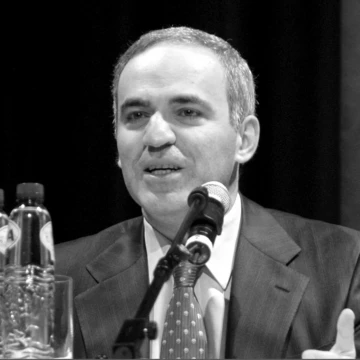
Wilhelm Steinitz
First World Chess Champion and founder of modern positional play.

via Wikipedia: Wilhelm Steinitz · see source
Wilhelm Steinitz (May 14, 1836 – August 12, 1900) was a Bohemian-Austrian, and later American, chess player. From 1886 to 1894, he was the first World Chess Champion. He was also a highly influential writer and chess theoretician. Statistical rating systems give Steinitz a rather low ranking among world champions, mainly because he took several long breaks from competitive play. However, an analysis based on one of these rating systems shows that he was one of the most dominant players in the history of the game. Steinitz was unbeaten in match play for 32 years, from 1862 to 1894.
- born
- May 14, 1836
- died
- August 12, 1900
- field
- Chess
- nationality
- Bohemian-Austrian, later American
- known_for
- First World Chess Champion; pioneer of positional chess
Verified Timeline
Lore & Background
Steinitz was born on May 14, 1836, in the Jewish ghetto of Prague, the youngest of tailor Josef-Salomon Steinitz's thirteen sons by his first wife. He learned to play chess at age 12. After studying Talmud in his youth, he left Prague in 1857 to study mathematics at the Vienna Polytechnic, spending two years at the university. He improved rapidly in chess during the late 1850s, progressing from third place in the 1859 Vienna City championship to first in 1861 with a score of 30/31, earning the nickname 'the Austrian Morphy.' He was sent to represent Austria in the London 1862 chess tournament, placed sixth, and won the brilliancy prize for his win over Augustus Mongredien. He then challenged and beat Serafino Dubois (five wins, one draw, three losses), turned professional, and settled in London. In 1862–63 he scored a crushing win in a match with Joseph Henry Blackburne, then beat Frederick Deacon, Augustus Mongredien (1863), and Valentine Green (1864). In 1866 he defeated Adolf Anderssen, regarded as the world's strongest active player, with eight wins and six losses (no draws); after 12 games the scores were level at 6–6, then Steinitz won the last two games. As a result, Steinitz was generally regarded as the world's best player. He beat Henry Bird in 1866 (seven wins, five losses, five draws) and comfortably beat Johannes Zukertort in 1872 (seven wins, four draws, one loss). At the Vienna 1873 chess tournament, Steinitz unveiled a new positional style of play, tying for first place with Blackburne and winning the play-off. He made a shaky start but won his last 14 games in the main tournament plus the two play-off games, starting a 25-game winning streak in serious competition. Between 1873 and 1882 Steinitz played no tournaments and only one match (a 7–0 win against Blackburne in 1876), instead concentrating on chess journalism for The Field. His debates with Zukertort and Leopold Hoffer in The Chess Monthly escalated into the 'Ink War,' which sharpened in 1881 when Steinitz mercilessly criticized Hoffer's annotations of games from the 1881 Berlin Congress. Steinitz lost his world title to Emanuel Lasker in 1894 and lost a rematch in 1896–97.
Reader's Guide
Steinitz's significance lies in his transformation of chess from the all-out attacking 'Romantic' style to a positional style of play. He unveiled this new approach at the Vienna 1873 chess tournament and demonstrated it was superior, though some branded it 'cowardly.' Many of Steinitz's games showed it could also set up attacks as ferocious as those of the old school. He defended his ideas vigorously in writing, and the debate became known as the 'Ink War.' By the early 1890s, his approach was widely accepted, and the next generation of top players, including his successor Emanuel Lasker, acknowledged their debt to him. Statistical rating systems give Steinitz a low ranking among world champions due to long breaks from play, but one analysis shows he was one of the most dominant players ever, unbeaten in match play for 32 years (1862–1894). From 1888 to 1889 he co-operated with the American Chess Congress in a project to define rules governing the conduct of future world championships. Traditional accounts depict him as ill-tempered and aggressive, but more recent research shows he had long and friendly relationships with some players and chess organizations. He was unskilled at managing money and lived in poverty all his life.
Did You Know?
- Steinitz was unbeaten in match play for 32 years, from 1862 to 1894.
- He learned to play chess at age 12 and studied Talmud in his youth before studying mathematics at the Vienna Polytechnic.
- Steinitz's win over Adolf Anderssen in 1866 had a prize of £100 to the winner and £20 to the loser, equivalent to about £57,500 in 2007's money.
- At the Vienna 1873 chess tournament, Steinitz started a 25-game winning streak in serious competition after unveiling his new positional style.
- From 1888 to 1889 he co-operated with the American Chess Congress to define rules for future world championships.
Frequently Asked Questions
Who is Wilhelm Steinitz?
Wilhelm Steinitz was a chess player born in 1836 in Bohemia under the Austrian Empire who later emigrated to the United States. He is best remembered as the very first person to officially hold the title of World Chess Champion.
Why is Wilhelm Steinitz important in chess history?
He is widely regarded as the father of modern positional chess, fundamentally shifting the game's emphasis from flashy tactical attacks to deeper strategic planning. His ideas about control, structure, and long-term advantage still underpin how the game is taught today.
When did Wilhelm Steinitz hold the World Chess Championship?
Steinitz reigned as World Chess Champion from 1886 until 1894, a span of eight years. He ultimately lost the title to Emanuel Lasker in their 1894 match.
What nationality was Wilhelm Steinitz?
He was born a subject of the Austrian Empire in what is now the Czech Republic, making him Bohemian-Austrian by origin. He later moved to the United States and became an American citizen.
What did Wilhelm Steinitz contribute to chess theory?
He was a prolific writer and theoretician who argued that true chess mastery depended on understanding positional principles rather than merely spotting brilliant tactical combinations. His treatises helped establish the strategic framework that still forms the backbone of modern chess education.
More in Chess Masters 1-17
Spotted an error? Know more?
This is a living reference — every entry is fact-audited, and reader corrections feed straight into our audit queue. Suggest an edit · See this site's audit record