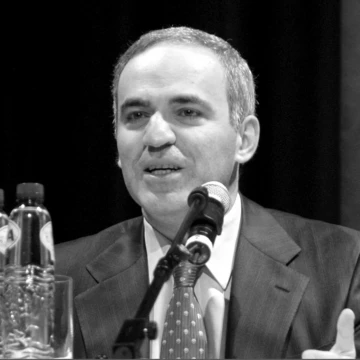
José Raúl Capablanca
Cuban chess prodigy and third world chess champion.

via Wikipedia: José Raúl Capablanca · see source
José Raúl Capablanca y Graupera was a Cuban chess player who was the third world chess champion from 1921 to 1927. A chess prodigy, he was widely renowned for his exceptional endgame skill and speed of play. He was undefeated from February 10, 1916, to March 21, 1924, a period that included his world championship match with Emanuel Lasker. Capablanca excelled in simple positions and endgames; Bobby Fischer described him as possessing a 'real light touch'. His style of chess influenced the play of future world champions Bobby Fischer and Anatoly Karpov.
- born
- 19 November 1888
- died
- 8 March 1942
- nationality
- Cuban
- known_for
- Third world chess champion; exceptional endgame skill; undefeated from February
Verified Timeline
Lore & Background
Capablanca was born in 1888 in the Castillo del Príncipe, Havana. He learned to play chess at the age of four by watching his father play with friends, pointed out an illegal move by his father, and then beat his father. At the age of eight he was taken to Havana Chess Club. He beat Cuban champion Juan Corzo in a match on 17 November 1901, two days before his 13th birthday. After studying at Columbia College and Columbia's School of Mines, Engineering and Chemistry, he left after one semester to devote himself to chess full-time. His victory over Frank Marshall in a 1909 match earned him an invitation to the 1911 San Sebastián tournament, which he won ahead of players such as Akiba Rubinstein, Aron Nimzowitsch and Siegbert Tarrasch. He became world champion by defeating Emanuel Lasker in 1921. Capablanca lost the title in 1927 to Alexander Alekhine, who had never beaten Capablanca before the match. He withdrew from serious chess in 1931, made a comeback in 1934, and died in 1942 of a brain hemorrhage.
Reader's Guide
Capablanca's significance lies in his extraordinary endgame skill and his undefeated streak from February 10, 1916, to March 21, 1924, which included his world championship match with Lasker. He excelled in simple positions and endgames, and Bobby Fischer described him as possessing a 'real light touch.' He could play tactical chess when necessary and had good defensive technique. His book Chess Fundamentals was regarded by Mikhail Botvinnik as the best chess book ever written. Capablanca preferred not to present detailed analysis but focused on critical moments in a game. His style influenced the play of future world champions Bobby Fischer and Anatoly Karpov. Despite losing the title to Alekhine, he continued excellent tournament results before withdrawing from serious chess in 1931. His legacy endures as one of the greatest natural talents in chess history.
Did You Know?
- Capablanca learned to play chess at age four by watching his father play with friends, pointed out an illegal move by his father, and then beat his father.
- He beat Cuban champion Juan Corzo in a match on 17 November 1901, two days before his 13th birthday.
- Capablanca was undefeated from February 10, 1916, to March 21, 1924, a period that included his world championship match with Lasker.
- Alexander Alekhine had never beaten Capablanca before their 1927 world championship match, in which Alekhine won the title.
- Mikhail Botvinnik regarded Capablanca's book Chess Fundamentals as the best chess book ever written.
The Havana Prodigy
Capablanca was born on 19 November 1888 at the Castillo del Príncipe in Havana, the second surviving son of a Spanish army officer and a Spanish woman from Catalonia. His first encounter with chess was entirely self-directed: at four, watching his father play with friends, he spotted an illegal move and then beat him. By eight he was a regular at the Havana Chess Club, though a physician advised limiting how often he sat at the board. The first public proof of his gift arrived in late 1901, when a thirteen-year-old Capablanca defeated Cuban champion Juan Corzo in a match ending two days before his birthday. His path was not smooth—he placed fourth out of six in the 1902 National Championship, losing both games to Corzo—but by 1905 he had sailed to New York, passed Columbia College's entrance exams, and briefly played shortstop for the freshman baseball team before the Manhattan Chess Club identified him as its strongest player. A 1906 rapid tournament win over reigning world champion Emanuel Lasker cemented his standing. He left Columbia in 1908 to focus on chess, and a brief 1910 stint studying chemical engineering at Columbia's School of Mines, Engineering and Chemistry ended after one semester when his financial support was withdrawn because he preferred playing chess to studying engineering.
From Exhibition Tours to the World Title
The 1909 simultaneous exhibition tour across twenty-seven American cities—six hundred and two games at a 96.4 percent score—transformed Capablanca into a global sensation. The tour earned him a sponsored match against US champion Frank Marshall, which Capablanca won 15–8 (8 wins, 1 loss, 14 draws), a margin comparable to what Lasker had posted over Marshall in their 1907 world championship. Remarkably, Capablanca said that he had never opened a book on chess openings. The following years brought further validation: a 1910 New York State Championship victory and a second-place finish at the 1911 National Tournament, followed by the landmark San Sebastián event. There, in what was considered one of the strongest five tournaments held up to that time, a twenty-two-year-old Capablanca stunned the chess world by taking first place with six wins, one loss and seven draws ahead of Rubinstein, Vidmar, Marshall, Schlechter, and Tarrasch, despite objections from Bernstein and Nimzowitsch about his eligibility. His single loss, to Rubinstein, was later hailed as one of Rubinstein's finest achievements. After several failed attempts to arrange a match with Lasker, Capablanca finally dethroned the world champion in 1921, capping an extraordinary undefeated streak stretching from February 10, 1916 through March 21, 1924.
Elegance, Economy, and a Lasting Pedagogical Voice
Capablanca's chess was defined by an almost preternatural comfort in simplified positions and endgames, a quality Bobby Fischer later captured in the phrase 'real light touch.' He was no one-dimensional player: when tactical violence was called for, he could deliver it, and his defensive technique was consistently strong. What set him apart was the economy of his thought—he preferred to steer toward clean, minimal positions rather than tangled middlegames, and his speed at the board made him formidable in rapid play as well as classical time controls. His influence extended well beyond the board. He authored several chess books during his career, and his Chess Fundamentals was singled out by Mikhail Botvinnik as the best chess book ever written. In his writing, Capablanca eschewed exhaustive variation trees in favor of highlighting the critical turning points of a game, a pedagogical choice that resonated for generations. Two future world champions, Bobby Fischer and Anatoly Karpov, openly acknowledged that Capablanca's style shaped their own approach, ensuring his fingerprints remained visible in top-level chess long after his death.
The Loss, the Silence, and the End
Capablanca's reign as third world champion lasted six years, from his 1921 coronation until Alexander Alekhine stripped the title from him in 1927. The humiliation was compounded by the fact that Alekhine had never beaten Capablanca before the match, making the defeat all the more jarring. For years afterward, Capablanca sought a rematch, but negotiations repeatedly collapsed and the relationship between the two men soured into open bitterness. Even so, his tournament form remained excellent through the late 1920s and into the early 1930s. In 1931, however, he stepped away from serious competitive chess entirely. A comeback in 1934 produced respectable results but also revealed troubling symptoms of high blood pressure that would ultimately prove fatal. On 8 March 1942, José Raúl Capablanca y Graupera died of a brain hemorrhage, ending the life of a man who had once gone over eight years without a single defeat. His legacy endures not only in the records of his matches but in the way his elegant, simplified style continues to inform how the game is taught and played.
Frequently Asked Questions
Who is José Raúl Capablanca?
Capablanca was a Cuban chess prodigy who became the third world chess champion in 1921. He is widely regarded as one of the finest endgame players the game has ever produced.
What made Capablanca's playing style so distinctive?
He was celebrated for his lightning-fast calculation and an almost intuitive command of endgame positions. His natural, effortless approach set him apart from the more methodical players of his era and later inspired champions like Fischer and Karpov.
How long did Capablanca hold the world chess title?
He served as world champion from 1921 until he lost the title to Alexander Alekhine in 1927. He never managed to reclaim the championship in any subsequent match.
What is Capablanca's famous unbeaten streak?
From February 1916 to March 1924, Capablanca went an extraordinary eight years without losing a single game. This record remains one of the most impressive feats in chess history.
How did Capablanca's life and career end?
After losing the world title in 1927, he continued competing at a high level but never regained the championship. He passed away on 8 March 1942 in New York City.
More in Chess Masters 1-17
Related in Chess Masters
Links follow this subject's own source article.
Spotted an error? Know more?
This is a living reference — every entry is fact-audited, and reader corrections feed straight into our audit queue. Suggest an edit · See this site's audit record