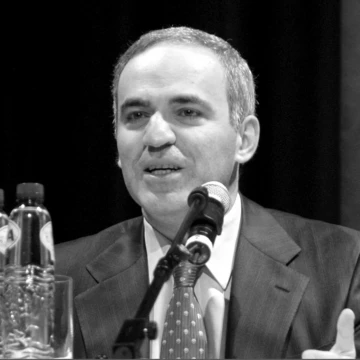
Emanuel Lasker
Second World Chess Champion, held title for 27 years; won the championship once and defended it six times.

via Wikipedia: Emanuel Lasker · see source
Emanuel Lasker was a German chess player, mathematician, and philosopher. He was the second World Chess Champion, holding the title for 27 years from 1894 to 1921, the longest reign of any officially recognised World Chess Champion. He won the championship once and successfully defended it six times.
- born
- December 24, 1868
- died
- January 11, 1941
- nationality
- German
- known_for
- Longest-reigning World Chess Champion; contributions to commutative algebra
Verified Timeline
Lore & Background
Emanuel Lasker was born on December 24, 1868, at Berlinchen in Neumark, the son of a Jewish cantor. At age eleven he was sent to study mathematics in Berlin, where he lived with his brother Berthold, who taught him chess. To supplement their income, Lasker played chess and card games for small stakes at the Café Kaiserhof. He won the Café Kaiserhof's annual Winter tournament 1888/89 and the Hauptturnier A at the sixth DSB Congress in Breslau, earning the title of 'master'. He then finished second at an international tournament in Amsterdam and won two tournaments in London in spring 1892, the second without losing a game. At New York City in 1893, he won all thirteen games, achieving a perfect score in a significant tournament. His match record from 1889 to 1893 included victories over top-class opponents such as Curt von Bardeleben, Jacques Mieses, Henry Edward Bird, Berthold Englisch, Joseph Henry Blackburne, Jackson Showalter, and Celso Golmayo Zúpide. After Siegbert Tarrasch declined a challenge, Lasker challenged reigning World Champion Wilhelm Steinitz. The match was played in 1894 in New York, Philadelphia, and Montreal. Lasker won convincingly with ten wins, five losses, and four draws, becoming the second formally recognized World Chess Champion. He confirmed his title by beating Steinitz even more convincingly in their rematch in 1896–97. Lasker then won first prizes at very strong tournaments in St Petersburg 1895–96, Nuremberg 1896, London 1899, and Paris 1900. He later overcame a 1½-point deficit at St Petersburg 1914 to finish ahead of rising stars Capablanca and Alexander Alekhine. His match record remained impressive, including a 1907 world championship match against Frank Marshall, where Marshall could not win a single game, and a 1908 match against Tarrasch, whom Lasker defeated.
Reader's Guide
Emanuel Lasker's significance lies in his unprecedented 27-year reign as World Chess Champion, the longest of any officially recognised champion, and his dominance in an era of strong competitors. Contemporaries noted his 'psychological' approach, sometimes accusing him of deliberately playing inferior moves to confuse opponents. Recent analysis, however, indicates he was ahead of his time, using a more flexible approach that mystified many. He published chess magazines and five chess books, though later players found it difficult to draw lessons from his methods. Beyond chess, Lasker was a first-class contract bridge player and wrote about bridge, Go, and his own invention, Lasca. His books on games presented a problem still notable in the mathematical analysis of card games. As a research mathematician, he contributed to commutative algebra, proving the primary decomposition of the ideals of polynomial rings. He also produced philosophical writings and co-authored a drama, both receiving limited contemporary attention. His legacy includes both his competitive achievements and his intellectual contributions across multiple fields.
Did You Know?
- Lasker's 27-year reign as World Chess Champion (1894–1921) is the longest of any officially recognised champion.
- At New York City in 1893, Lasker won all thirteen games, one of the few perfect scores in a significant tournament.
- Lasker invented his own game called Lasca and wrote about bridge and Go.
- He proved the primary decomposition of the ideals of polynomial rings, a key result in commutative algebra.
- In the 1908 match against Tarrasch, Lasker won four of the first five games after Tarrasch refused to speak to him, saying only 'Mr. Lasker, I have only three words to say to you: check and mate!'
The Longest Reign in Chess History
Emanuel Lasker claimed the World Chess Championship in 1894 and held it for an extraordinary twenty-seven years, until 1921 — a span no other officially recognized champion has matched. During that era he captured the title six times, and in his prime he was arguably the most dominant force the game had ever seen. His ascent was meteoric: after a flawless thirteen-game victory in New York in 1893 and a lossless triumph in London the year before, he turned his attention to the reigning champion, Wilhelm Steinitz. The 1894 match, staged across New York, Philadelphia, and Montreal, saw Lasker seize a five-game winning streak in the middle stretch that proved decisive. He finished with ten wins, five losses, and four draws. When the two met again in 1896–97, Lasker was even more commanding, taking ten wins to two losses. His difficulty in raising the match stake — eventually settling at two thousand dollars a side — and the public skepticism from figures like Gunsberg and Hoffer only sharpened the narrative of an underdog who silenced his doubters.
The Mind Behind the Moves
Contemporaries often described Lasker as a psychological player, claiming he would deliberately choose inferior moves to unsettle his opponents. Modern retrospective analysis paints a more nuanced picture: Lasker was simply ahead of his time, employing a flexible, positionally rich approach that the chess world of the 1890s and 1900s was not yet equipped to appreciate. He studied the prevailing opening theory thoroughly but frequently disagreed with its conclusions, preferring to steer games into middlegame complications where his tactical and strategic instincts shone. He published five chess books and founded at least one magazine — The London Chess Fortnightly in 1892 — yet later commentators have struggled to extract systematic lessons from his methods. His style resisted easy categorization, which is perhaps why his reputation as a trickster persisted long after his playing days ended.
Beyond the Chessboard
Lasker's intellectual life extended well beyond chess. As a research mathematician, he made significant contributions to commutative algebra, most notably proving the primary decomposition of ideals in polynomial rings — a result that remains a cornerstone of the field. In the world of games, he was a first-class contract bridge player and authored writings on bridge, the ancient Asian game of Go, and his own invention, Lasca. His books on games posed a problem that is still regarded as notable in the mathematical analysis of card games. Beyond these, Lasker produced philosophical writings and co-authored a drama, though both received only limited attention from his contemporaries. This breadth of engagement — spanning rigorous algebra, recreational game theory, and speculative philosophy — paints a picture of a mind that refused to be confined to a single discipline, even as chess consumed the public's perception of him.
From a Cantor's Son to Master
Emanuel Lasker was born on December 24, 1868, in Berlinchen, Neumark (today Barlinek, Poland), the son of a Jewish cantor. At eleven, he moved to Berlin to study mathematics, living with his elder brother Berthold, who was himself among the world's top ten players by the early 1890s. Berthold taught Emanuel chess, and the brothers supplemented their household income by playing chess and card games for small stakes at the Café Kaiserhof. Lasker's breakthrough came at the sixth DSB Congress in Breslau, where he won the second-division Hauptturnier. The drama of that final is remarkable: with two rounds remaining, Lasker trailed Viennese amateur von Feierfeil by a point and a half. Lasker won both his remaining games while von Feierfeil suffered a 121-move mate after a position was incorrectly reconstructed following an adjournment. The tie was broken in Lasker's favor, earning him the master title and opening the door to the international tournaments that would define his career.
Frequently Asked Questions
Who is Emanuel Lasker?
Emanuel Lasker was a German chess master, mathematician, and philosopher, best remembered as the second official World Chess Champion. He was born on December 24, 1868, and died on January 11, 1941.
How long did Lasker hold the World Chess Championship?
He kept the title for 27 years, from 1894 through 1921, which makes him the longest-reigning officially recognised World Chess Champion in the history of the game.
What did Lasker contribute outside of chess?
In addition to his chess career, Lasker made notable contributions to the field of commutative algebra and wrote on philosophical subjects, earning him a reputation as a genuine polymath.
How many times did Lasker defend his World Championship title?
He won the championship once in 1894 and then successfully defended it on six separate occasions before his reign ended in 1921.
Why is Lasker considered so important in chess history?
His 27-year stretch as champion spans nearly three decades and remains the longest continuous hold of the title by any officially recognised world champion. His intellectual range across mathematics and philosophy further set him apart in the annals of the game.
More in Chess Masters 1-17
Related in Chess Masters
Links follow this subject's own source article.
Spotted an error? Know more?
This is a living reference — every entry is fact-audited, and reader corrections feed straight into our audit queue. Suggest an edit · See this site's audit record