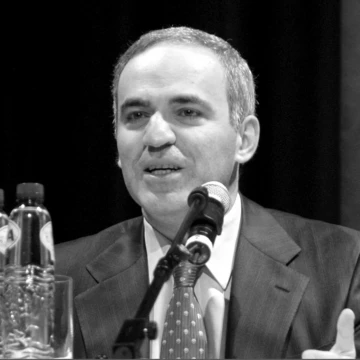
Judit Polgár
Hungarian chess grandmaster, strongest female player in history.

via Wikipedia: Judit Polgár · see source
Judit Polgár (born 23 July 1976) is a Hungarian chess grandmaster, widely regarded as the strongest female chess player of all time. She is the only woman to be ranked in the world top 10, the only woman to achieve a rating over 2700, reaching a peak rating of 2735, and the only woman to compete in the final stage of a World Chess Championship. She was the top-rated woman in the world from January 1989 until her retirement from competitive chess in 2014, remaining No. 1 until the March 2015 rating list, a record of 26 consecutive years as woman's No. 1.
- born
- 23 July 1976
- nationality
- Hungarian
- known_for
- Strongest female chess player in history; only woman ranked in world top 10; you
Verified Timeline
Lore & Background
Polgár was born on 23 July 1976 in Budapest to a Jewish-Hungarian family. She and her two older sisters, Grandmaster Susan and International Master Sofia, were part of an educational experiment carried out by their father, László Polgár, to prove that children could make exceptional achievements if trained in a specialist subject from a very early age. 'Geniuses are made, not born,' was László's thesis. He and his wife Klára educated their three daughters at home, with chess as the specialist subject. From the beginning, László was against the idea that his daughters had to participate in female-only events, putting the family in conflict with the Hungarian Chess Federation, whose policy was for women to play in women-only tournaments. A chess prodigy, Polgár first defeated an International Master, Dolfi Drimer, at age 10 and a grandmaster, Lev Gutman, at age 11. At age 12, she became the youngest player to break into the FIDE top-100 rating list, ranked 55 in the January 1989 list. In 1991, she became the youngest player at the time to achieve the title of Grandmaster, at the age of 15 years and 4 months, breaking the 33-year-old record held by former world champion Bobby Fischer. She rarely played in women-only tournaments and never competed for the Women's World Championship, stating: 'I always say that women should have the self-confidence that they are as good as male players, but only if they are willing to work and take it seriously as much as male players.'
Reader's Guide
Judit Polgár's significance lies in her demonstration that women can compete at the highest levels of chess, a traditionally male-dominated field. She was the top-rated woman in the world from January 1989 until her retirement in 2014, holding the number one spot for 26 consecutive years. She is the only woman to have won a game against a reigning world number one player (Garry Kasparov, in 2002) and defeated eleven current or former world champions in either rapid or classical chess: Magnus Carlsen, Anatoly Karpov, Kasparov, Vladimir Kramnik, Boris Spassky, Vasily Smyslov, Veselin Topalov, Viswanathan Anand, Ruslan Ponomariov, Alexander Khalifman, and Rustam Kasimdzhanov. Her career challenged assumptions about gender and intellectual achievement, and her father's educational experiment strengthened the argument for nurture over nature. After retiring from competitive chess on 13 August 2014, she was elected as the new captain and head coach of the Hungarian national men's team in June 2015. On 20 August 2015, she received Hungary's highest decoration, the Grand Cross of the Order of Saint Stephen of Hungary. In 2021, Polgár was inducted into the World Chess Hall of Fame. In September 2024, as part of FIDE's centennial celebration, Polgár was awarded the FIDE 100 Award as the best female player of the past 100 years.
Did You Know?
- At age 5, Judit Polgár defeated a family friend without looking at the board. When the friend joked, 'You are good at chess, but I'm a good cook,' Judit replied: 'Do you cook without looking at the stove?'
- Polgár is the only woman to have won a game against a reigning world number one player—she defeated Garry Kasparov in 2002.
- She was the top-rated woman in the world from January 1989 until her retirement in 2014, a record of 26 consecutive years as woman's No. 1.
- In 1991, at 15 years and 4 months, she broke Bobby Fischer's 33-year-old record to become the youngest grandmaster at the time.
- Polgár never competed for the Women's World Championship, stating that women should have the self-confidence that they are as good as male players if they work hard.
Youngest Grandmaster in History
In 1991, at 15 years and 4 months, Judit Polgár became the youngest player at the time to achieve the title of Grandmaster, breaking the 33-year-old record held by former world champion Bobby Fischer. With the achievement, she became only the fourth-ever female Grandmaster, achieving the title the same year her older sister Susan had become the third-ever female Grandmaster. Polgár's accomplishment was earned through the same rigorous standards applied to every other grandmaster, not through a special-case award or a women's championship win. At age 12, she had already become the youngest player to break into the FIDE top-100 rating list, ranked 55 in the January 1989 list. Her record as the youngest grandmaster at the time stood as a landmark in chess history, demonstrating that a teenage girl could compete at the highest levels of open competition.
The Polgár Sisters and the End of Soviet Dominance
In November 1988, Judit and her sisters, along with Ildikó Mádl, represented Hungary in the Women's section of the 28th Chess Olympiad in Thessaloniki. The International Chess Federation would not permit the Polgárs to play against men in team competitions. Prior to the tournament, Soviet GM Eduard Gufeld dismissed the Polgárs, saying: 'I believe that these girls are going to lose a good part of their quickly acquired image in the 28th Olympiad... Afterward we are going to know if the Hungarian sisters are geniuses or just women!' However, the Hungarian women's team won the championship, which marked the first time it was not won by the Soviet Union. Judit played board 2 and finished the tournament with the highest score of 12½–½ to win the individual gold. The sisters' combined trajectory demonstrated that elite chess talent was no longer the exclusive province of one nation or one gender, reshaping expectations for what young women could achieve in open competition.
Among the Elite: A Top-100 Standing
Judit Polgár's peak rating of 2735 placed her among the world's elite players. She is the only woman to be ranked in the world top 10 and the only woman to achieve a rating over 2700. At age 12, she became the youngest player to break into the FIDE top-100 rating list, ranked 55 in the January 1989 list. Her 2002 victory against reigning world number one Garry Kasparov demonstrated that she could compete at the very highest level of the game. Polgár's consistent presence in the top rankings over decades—she was the top-rated woman in the world from January 1989 until her retirement in 2014, a record of 26 consecutive years—underscores her sustained excellence in a field where few women had ever broken into the global top 100.
A Record in a Growing Field
Judit Polgár's record as the youngest grandmaster at the time, set in 1991 at age 15 years and 4 months, broke the 33-year-old record held by Bobby Fischer. With the achievement, she became only the fourth-ever female Grandmaster, achieving the title the same year her older sister Susan had become the third-ever female Grandmaster. Polgár's accomplishment was a signal that the field of women's chess was about to expand in ways no one had previously imagined. She went on to win or share first in the chess tournaments of Hastings 1993, Madrid 1994, León 1996, U.S. Open 1998, Hoogeveen 1999, Sigeman & Co 2000, Japfa 2000, and the Najdorf Memorial 2000. Her career demonstrated that women could achieve the highest levels of chess excellence when given the opportunity and training.
Frequently Asked Questions
Who is Judit Polgár?
She is a Hungarian chess grandmaster born on 23 July 1976, widely recognized as the greatest female chess player in the history of the game.
What records does Judit Polgár hold?
She is the only woman ever to crack the world's top ten, to surpass a 2700 Elo rating, and to reach the final stage of a World Chess Championship.
How young was Judit Polgár when she earned her grandmaster title?
She became a grandmaster at just 15 years and 4 months old, making her the youngest player to achieve that rank at the time.
Why do fans consider Judit Polgár a landmark figure in chess?
She competed at the very top of the game against the world's leading male players, proving that women could reach the absolute elite level in chess.
What is Judit Polgár's nationality?
She is Hungarian.
More in Chess Masters 1-17
Related in Chess Masters
Links follow this subject's own source article.
Spotted an error? Know more?
This is a living reference — every entry is fact-audited, and reader corrections feed straight into our audit queue. Suggest an edit · See this site's audit record