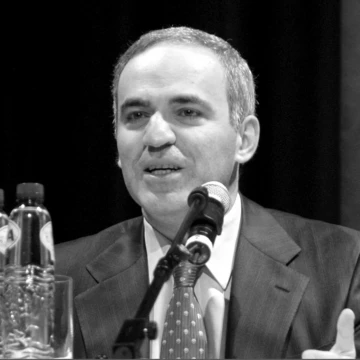
Aron Nimzowitsch
Hypermodern chess theorist and influential writer.

via Wikipedia: Aron Nimzowitsch · see source
Aron Nimzowitsch was a Russian-born Danish chess player and writer. In the late 1920s, he was one of the best chess players in the world. He was the foremost figure amongst the hypermoderns and wrote a very influential book on chess theory: *My System* (1925–1927).
- born
- 7 November 1886, Riga, Russian Empire
- died
- 16 March 1935
- field
- Chess player and writer
- nationality
- Russian-born Danish
- known_for
- Hypermodern chess theory, author of *My System* and *Chess Praxis*
Verified Timeline
Lore & Background
Nimzowitsch was born in Riga, then part of the Russian Empire, into a wealthy Jewish Yiddish-speaking family. He learned chess from his father Shaya Abramovich Nimzowitsch, a timber merchant. By 1897 the family lived in Dvinsk. In 1904 he travelled to Berlin to study philosophy, but set aside his studies soon and began a career as a professional chess player that same year. He won his first international tournament at Munich 1906, then tied for first with Alexander Alekhine at Saint Petersburg 1913/14. During the 1917 Russian Revolution he was in the Baltic war zone and escaped being drafted by feigning madness, insisting that a fly was on his head. He then escaped to Berlin, giving his first name as Arnold, possibly to avoid anti-Semitic persecution. He moved to Copenhagen in 1922, where he lived for the rest of his life in one small rented room. He won the Nordic Championship twice, in 1924 and 1934, obtained Danish citizenship, and lived in Denmark until his death in 1935.
Reader's Guide
Nimzowitsch is considered one of the most important players and writers in chess history. His works influenced numerous players, including Savielly Tartakower, Milan Vidmar, Richard Réti, Akiba Rubinstein, Mikhail Botvinnik, Bent Larsen, Viktor Korchnoi, and Tigran Petrosian. His book *My System* is considered one of the most influential chess books of all time, setting out his most important ideas including overprotection, blockade, prophylaxis, and controlling the center with pieces instead of pawns. *Chess Praxis* elaborates upon these ideas and has immense value as a collection of his own games with his idiosyncratic, hyperbolic commentary. His theories challenged the orthodoxies of Siegbert Tarrasch. Many openings bear his name, including the Nimzo-Indian Defence and the Nimzowitsch Defence. He never beat Capablanca (+0−5=6) but fared better against Alekhine (+3−9=9). His most famous game is the celebrated immortal zugzwang game against Sämisch at Copenhagen 1923.
Did You Know?
- Nimzowitsch escaped being drafted during the 1917 Russian Revolution by feigning madness, insisting that a fly was on his head.
- He gave his first name as Arnold after escaping to Berlin, possibly to avoid anti-Semitic persecution.
- Nimzowitsch's book *Chess Praxis* was purchased by a pre-teen future World Champion Tigran Petrosian and greatly influenced his development.
- He never beat Capablanca in their six games together, with a record of +0−5=6.
- Nimzowitsch once stood on a table and shouted 'Gegen diesen Idioten muss ich verlieren!' ('I must lose to this idiot!') after losing to Sämisch.
Tournament Dominance and the Limits of Match Play
The height of Nimzowitsch's career was the late 1920s and early 1930s. Chessmetrics places him as the third best player in the world from 1927 to 1931, behind Alexander Alekhine and José Capablanca. His most notable successes were first-place finishes at Copenhagen 1923, Marienbad 1925, Dresden 1926, Hanover 1926, and the Carlsbad 1929 chess tournament, and second place behind Alekhine at the San Remo 1930 chess tournament. Earlier, he had won his first international tournament at Munich 1906 and tied for first with Alekhine at Saint Petersburg 1913/14. Nimzowitsch never developed a knack for match play; his best match success was a draw with Alekhine, but the match consisted of only two games and took place in 1914, thirteen years before Alekhine became world champion. He never beat Capablanca (+0−5=6), but fared better against Alekhine (+3−9=9), even beating Alekhine with the black pieces in their short 1914 match at St. Petersburg. When in form, Nimzowitsch was very dangerous with the black pieces, scoring many fine wins over top players.
The Hypermodern Revolution and a New Chess Lexicon
Nimzowitsch was the foremost figure amongst the hypermoderns. His chess theories flew in the face of widely held orthodoxies enunciated by Siegbert Tarrasch and his disciples. Tarrasch's rigid generalizations drew on the earlier work of Wilhelm Steinitz. Nimzowitsch supplemented many of the earlier simplistic assumptions about chess strategy by enunciating general concepts of defensive play. Notable in his 'system' were concepts such as overprotection of pieces and pawns under attack, control of the center by pieces instead of pawns, blockading of opposing pieces (notably passed pawns), and prophylaxis. He was also a leading exponent of the fianchetto development of bishops. He formulated the terminology still in use for various complex chess strategies; he was the first to present them systematically as a lexicon of themes. His game versus Paul Johner at Dresden 1926 is a great example of his concept of 'first restrain, then blockade and finally destroy'—he manoeuvred the black queen from its starting point to h7 to form a part of kingside blockade along with the knight on f6 and h-pawn. His three books—*My System* (1925), *Die Blockade* (1925), and *Chess Praxis* (1929)—established his reputation. His works influenced numerous players including Savielly Tartakower, Milan Vidmar, Richard Réti, Akiba Rubinstein, Mikhail Botvinnik, Bent Larsen, Viktor Korchnoi, and Tigran Petrosian, and his influence is still felt today.
A Life Shaped by Displacement and Simplicity
Born in Riga, then part of the Russian Empire, the Jewish Yiddish-speaking Nimzowitsch came from a wealthy family, where he learned chess from his father Shaya Abramovich Nimzowitsch (1860–1918), a timber merchant. By 1897, the family lived in Dvinsk. His mother was Esphir Nohumovna Nimzowitsch (born Rabinovich, 1865–1937); he had a sister Tsilya-Kreyna Pevzner and brothers Yakov, Osey, and Benno. In 1904 he travelled to Berlin to study philosophy, but set aside his studies soon and began a career as a professional chess player that same year. During the 1917 Russian Revolution, Nimzowitsch was in the Baltic war zone. He escaped being drafted into one of the armies by feigning madness, insisting that a fly was on his head. He then escaped to Berlin, and gave his first name as Arnold, possibly to avoid anti-Semitic persecution. Nimzowitsch eventually moved to Copenhagen in 1922, where he lived for the rest of his life in one small rented room. In Copenhagen, he won the Nordic Championship twice, in 1924 and in 1934. He obtained Danish citizenship and lived in Denmark until his death in 1935.
Signature Games and Enduring Reputation
One of Nimzowitsch's most famous games is his celebrated immortal zugzwang game against Sämisch at Copenhagen 1923. Another game on this theme is his win over Paul Johner at Dresden 1926. In that game, he manoeuvred the black queen from its starting point to h7 to form a part of kingside blockade along with the knight on f6 and h-pawn to stop any attacking threats from White. Raymond Keene writes that Nimzowitsch 'was one of the world's leading grandmasters for a period extending over a quarter of a century, and for some of that time he was the obvious challenger for the world championship. ... [He was also] a great and profound chess thinker second only to Steinitz, and his works – *Die Blockade*, *My System* and *Chess Praxis* – established his reputation as one of the father figures of modern chess.' GM Robert Byrne called him 'perhaps the most brilliant theoretician and teacher in the history of the game.' GM Jan Hein Donner called Nimzowitsch 'a man who was too much of an artist to be able to prove he was right and who was regarded as something of a madman in his time. He would be understood only long after his death.'
Frequently Asked Questions
Who is Aron Nimzowitsch?
Aron Nimzowitsch was a chess grandmaster born in Riga in 1886 who later became a Danish citizen. He ranked among the world's top players during the late 1920s and is best remembered as a leading voice of hypermodern chess theory.
What is Aron Nimzowitsch's role in chess history?
He served as the central figure of the hypermodern school, challenging classical positional thinking by advocating dynamic piece play and strategic flexibility. His ideas reshaped how players approached the middlegame and pawn structure.
What are Aron Nimzowitsch's most famous works?
His book *My System*, published between 1925 and 1927, remains one of the most widely read chess strategy texts ever written. He also authored *Chess Praxis*, which offered practical guidance drawn from his own tournament games.
How does Aron Nimzowitsch's story end?
Nimzowitsch passed away on 16 March 1935 in Copenhagen, Denmark, at the age of forty-eight. His death cut short what many considered a still-rising career, yet his theoretical legacy endured well beyond his lifetime.
Why is Aron Nimzowitsch important to chess fans?
He bridged the gap between classical and modern chess thinking, introducing concepts like the logical pawn break and centralized piece activity that players still study today. His writing made advanced strategy accessible, influencing generations of players from club level to the top of the game.
More in Chess Masters 1-17
Related in Chess Masters
Links follow this subject's own source article.
Spotted an error? Know more?
This is a living reference — every entry is fact-audited, and reader corrections feed straight into our audit queue. Suggest an edit · See this site's audit record