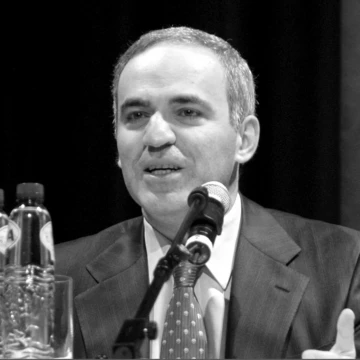
Anatoly Karpov
12th World Chess Champion and longtime dominant grandmaster.

via Wikipedia: Anatoly Karpov · see source
Anatoly Yevgenyevich Karpov is a Russian and former Soviet chess grandmaster, former World Chess Champion, and politician. He was the 12th World Chess Champion from 1975 to 1985, a three-time FIDE World Champion (1993, 1996, 1998), and a six-time winner of Chess Olympiads as a member of the USSR team. Karpov is known for his long dominance in chess, holding the world number one ranking for 102 total months, the third-longest of all time, behind Magnus Carlsen and Garry Kasparov.
- born
- May 23, 1951
- field
- Chess grandmaster, politician
- nationality
- Russian, former Soviet
- known_for
- 12th World Chess Champion, three-time FIDE World Champion, six-time Chess Olympi
Verified Timeline
Lore & Background
Karpov was born in Zlatoust, in the Urals region of the former Soviet Union, and learned chess at age four. He became a candidate master by 11 and was accepted into Mikhail Botvinnik's chess school at 12, despite Botvinnik saying that "[t]he boy does not have a clue about chess, and there's no future at all for him in this profession." By 15, he became the youngest Soviet master in history, tying Boris Spassky's record. He later studied mathematics at Moscow State University and economics at Leningrad State University, crediting grandmaster Semyon Furman as a major influence. Karpov's rise to the world championship was unusual: he became champion in 1975 without playing a match against reigning champion Bobby Fischer, after Fischer forfeited the title due to disputes over match conditions. Karpov then defended his title against Viktor Korchnoi in 1978 and 1981, winning both matches. He held the world championship for 16 years total, and for 25 consecutive years (1974–1998) he was either champion or challenger, a record surpassed only by Emanuel Lasker. Beyond his championship years, Karpov won over 160 tournament first-place finishes, including the Soviet Championship in 1976, 1983, and 1988. He also won the World Rapid Chess Championship in 1988 and received nine Chess Oscars from the International Association of Chess Press. In later life, he became a politician, serving as an elected Member of the State Duma and chairing the Commission for Ecological Safety and Environmental Protection of the Civic Chamber of the Russian Federation since 2006, and since 2007 a member of the Public Council under the Ministry of Defence.
Reader's Guide
Anatoly Karpov's significance lies in his extraordinary longevity at the top of world chess. For 25 consecutive years (1974–1998), he was either world champion or a championship challenger, a feat only Emanuel Lasker has surpassed. His 102 months as world number one rank third all time, behind Magnus Carlsen and Garry Kasparov. Karpov's tournament record—over 160 first-place finishes—demonstrates consistent dominance across decades. He also contributed to Soviet team successes, winning six Chess Olympiad gold medals. His career was marked by the unresolved question of his legitimacy after becoming champion without facing Bobby Fischer, but his subsequent defenses and tournament victories solidified his reputation. Karpov's legacy extends into politics, where he has held environmental and defense advisory roles in Russia. He is currently the oldest living World Chess Champion.
Did You Know?
- Karpov learned to play chess at the age of four.
- At age 15 in 1966, he became the youngest Soviet master in history, tying the record set by Boris Spassky in 1952.
- He became World Champion in 1975 without playing a match against reigning champion Bobby Fischer, after Fischer forfeited the title.
- Karpov's 102 total months as world number one is the third-longest of all time, behind Magnus Carlsen and Garry Kasparov.
- He is currently the oldest living World Chess Champion.
From the Urals to the World Stage
Anatoly Karpov entered the world on May 23, 1951, in Zlatoust, a town in the Urals region of the former Soviet Union. His introduction to chess came remarkably early — by the age of four he was already playing, and by eleven he had earned the candidate master title. At twelve, he was admitted to the renowned chess school run by Mikhail Botvinnik, a decision that initially surprised even the legendary trainer himself. Botvinnik reportedly told others that the boy "does not have a clue about chess" and saw no professional future for him. Karpov later admitted his theoretical understanding was muddled at that stage, but the rigorous homework Botvinnik assigned — requiring him to consult chess books and work diligently — proved transformative. His progress under that tutelage was extraordinary: in 1966, at just fifteen, he became the youngest Soviet master in history, matching a record Boris Spassky had set in 1952. What began as a child's game in a Ural town had already set the trajectory for a career that would reshape the chess world.
A Reign Measured in Records
Karpov's competitive résumé reads like a catalogue of superlatives. As the twelfth World Chess Champion, he held the crown from 1975 to 1985, and later claimed the FIDE World Championship three separate times in 1993, 1996, and 1998. His team achievements are equally remarkable: he was part of the Soviet squad that won the World Team Championship in 1985 and 1989, and he collected gold at six different Chess Olympiads spanning 1972 through 1988. In 1988 he also became the inaugural World Rapid Chess Champion. The International Association of Chess Press recognized his dominance with nine Chess Oscars spanning 1973 through 1984. Perhaps his most staggering statistic is the twenty-five consecutive years between 1974 and 1998 during which he was either the reigning world champion or an active challenger to the title — a streak surpassed in chess history only by Emanuel Lasker. His peak Elo rating reached 2780, and his 102 months at world number one rank third all-time, behind only Magnus Carlsen and Garry Kasparov. With more than 160 first-place tournament finishes to his name, Karpov's consistency over decades remains a benchmark in the sport.
The Title Without a Match
The path to Karpov's world championship was paved by a series of Candidates' matches that showcased his tenacity. After finishing equal first at the Leningrad Interzonal, he dispatched Lev Polugaevsky by the score of +3=5 in the first round, then defeated former champion Boris Spassky by a score of four wins, one loss, and six draws. The Candidates' final against Viktor Korchnoi in Moscow was a marathon of nineteen games, with Karpov ultimately prevailing three wins to two amid a sea of draws. Yet the moment that truly defined his ascent was not a game he played. Bobby Fischer, the reigning champion, demanded the match be contested to the first ten wins and that a nine-all tie would see him retain the title. FIDE refused to allow this condition and set an April 1, 1975 deadline. Fischer never agreed. On April 3, FIDE President Max Euwe declared the title forfeited, and Karpov — a twenty-four-year-old who had never faced Fischer over the board — became World Champion. Karpov later attempted to set up another match with Fischer, but the negotiations fell through, leaving one of chess's great rivalries forever unplayed.
Beyond the Sixty-Four Squares
Long after his playing days, Karpov has remained a prominent figure in Russian public life. He was elected as a Member of the State Duma, and since 2006 he has chaired the Commission for Ecological Safety and Environmental Protection of the Civic Chamber of the Russian Federation. Beginning in 2007, he also served on the Public Council under the Ministry of Defence, adding a national-security dimension to his civic portfolio. His political career stands in contrast to his earlier years, when, during the Brezhnev era, he was among the most celebrated and affluent citizens in the Soviet Union — reportedly owning one of only about four Mercedes-Benz cars in the entire country. On the academic front, he initially enrolled at Moscow State University to study mathematics before transferring to Leningrad State University, where he completed a degree in economics, partly to be closer to his coach Semyon Furman, whom he credits as a major influence on his development. Today, Karpov holds the distinction of being the oldest living World Chess Champion, a living link to an era when chess was a global spectacle.
Frequently Asked Questions
Who is Anatoly Karpov?
Anatoly Karpov is a Russian chess grandmaster who served as the 12th World Chess Champion from 1975 to 1985. He is also a politician and one of the most decorated players in the entire history of the game.
What are Karpov's major titles and achievements?
Karpov first captured the World Championship in 1975, later claimed three FIDE World Championship crowns in 1993, 1996, and 1998, and helped the Soviet team take gold at six Chess Olympiads.
How long did Karpov hold the world number one ranking?
He accumulated a total of 102 months at the top of the world rankings, a mark that places him third in the all-time list behind only a couple of other legends.
Why is Karpov considered so important to chess history?
His decade-long reign as World Champion and his sustained dominance at the very top of the game made him a defining figure of 1970s and 1980s chess. He is widely regarded as one of the most accomplished positional players the sport has ever produced.
What did Karpov do after his competitive chess career?
After stepping back from top-level competition, Karpov entered Russian politics, serving in various governmental and legislative roles. He also remains active as a chess commentator, author, and promoter of the game.
More in Chess Masters 1-17
Related in Chess Masters
Links follow this subject's own source article.
Spotted an error? Know more?
This is a living reference — every entry is fact-audited, and reader corrections feed straight into our audit queue. Suggest an edit · See this site's audit record