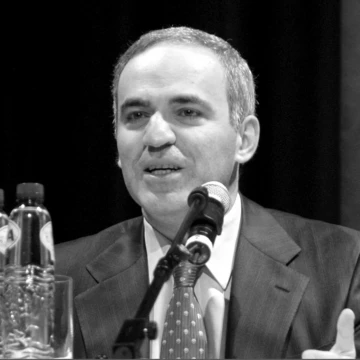
Alexander Alekhine
Fourth World Chess Champion, known for fierce attacking style.

via Wikipedia: Alexander Alekhine · see source
Alexander Alexandrovich Alekhine (October 31 [O.S. October 19] 1892 – March 24, 1946) was a Russian and French chess player and the fourth World Chess Champion, a title he held for two reigns. By age 22, he was already among the strongest players in the world. During the 1920s, he won most tournaments he entered. In 1921, he left Soviet Russia and emigrated to France, which he represented after 1925. In 1927, he became the fourth World Chess Champion by defeating José Raúl Capablanca. He is known for his fierce and imaginative attacking style, combined with great positional and endgame skill, and is highly regarded as a chess writer and theoretician, having produced innovations in a wide range of chess openings and given his name to Alekhine's Defence.
- born
- October 31, 1892 (Moscow, Russia)
- died
- March 24, 1946 (Portugal)
- field
- Chess
- nationality
- Russian, later French
- known_for
- Fourth World Chess Champion; Alekhine's Defence; attacking style
Verified Timeline
Lore & Background
Alekhine was born into a wealthy Russian family in Moscow on October 31, 1892, and was introduced to chess by his mother, his older brother Alexei, and his older sister Varvara. His first known game was from a correspondence chess tournament that began on December 3, 1902, when he was ten. By age 22, he was among the strongest players in the world. In 1921, he left Soviet Russia and emigrated to France, which he represented after 1925. He became the fourth World Chess Champion in 1927 by defeating José Raúl Capablanca. Alekhine defended his title against Efim Bogoljubov in 1929 and 1934, but was defeated by Max Euwe in 1935. He regained his crown in the 1937 rematch. During the early 1930s, he dominated tournament play and played first board for France in five Chess Olympiads, winning individual prizes in each (four medals and a brilliancy prize). Negotiations for a title match with Paul Keres or Mikhail Botvinnik were halted by the outbreak of World War II in Europe in 1939. Negotiations with Botvinnik for a world title match were proceeding in 1946 when Alekhine died in Portugal, in unclear circumstances. He is the only World Chess Champion to have died while holding the title.
Reader's Guide
Alekhine's significance lies in his reign as World Chess Champion and his enduring influence on chess strategy. His fierce attacking style, combined with deep positional and endgame skill, set a standard for aggressive play. He produced innovations in a wide range of chess openings, most notably Alekhine's Defence, and composed endgame studies. His tournament record was uneven in later years, but his two reigns as champion and his dominance in the 1920s and early 1930s cemented his legacy. The circumstances of his death in 1946 remain unclear, and he is the only world champion to die while holding the title. His contributions as a writer and theoretician continue to be studied.
Did You Know?
- Alekhine is the only World Chess Champion to have died while holding the title.
- His first known chess game was from a correspondence tournament that began on December 3, 1902, when he was ten years old.
- In July 1914, he was leading the Mannheim tournament with nine wins, one draw, and one loss when World War I broke out and he was interned in Rastatt, Germany.
- He played first board for France in five Chess Olympiads, winning individual prizes in each (four medals and a brilliancy prize).
- Negotiations for a title match with Mikhail Botvinnik were proceeding in 1946 when Alekhine died.
The Ascent to the Throne
Alexander Alekhine's path to the world championship was one of sustained excellence. Born in Moscow in 1892, he was already among the strongest players in the world by age 22, and throughout the 1920s he won most of the tournaments in which he played. His crowning achievement came in 1927, when he defeated José Raúl Capablanca to become the fourth World Chess Champion. The early 1930s cemented his dominance: he won two top-class tournaments by large margins and, representing France on first board across five Chess Olympiads, won individual prizes in each—four medals and a brilliancy prize. His title defenses against Efim Bogoljubov in 1929 and 1934 were handled with ease. Though Max Euwe defeated him in 1935, Alekhine regained the crown in their 1937 rematch. His tournament record, however, became uneven, and rising young stars like Paul Keres, Reuben Fine, and Mikhail Botvinnik threatened his title.
War, Exile, and an Unfinished Story
Alekhine's life was repeatedly interrupted by the upheavals of two world wars. In July–August 1914, while leading the Mannheim tournament with nine wins, one draw, and one loss, the outbreak of World War I trapped him and eleven fellow Russian players in internment at Rastatt, Germany. He was released on September 14, 1914, and made a long journey home through Switzerland, Italy, London, Sweden, and Finland by the end of October 1914. Back in Russia, he gave simultaneous exhibitions to raise money for the Russian chess players who remained interned. In 1921, he left Soviet Russia and emigrated to France, which he represented after 1925. World War II halted negotiations for a title match with Paul Keres or Mikhail Botvinnik in 1939. By 1946, negotiations with Botvinnik for a world title match were proceeding when Alekhine died in Portugal under circumstances that remain unclear. He became the only World Chess Champion to die while holding the title.
A Mind for Attack and Theory
Alekhine's reputation rests on a fusion of aggressive imagination and deep strategic understanding. His attacking play was fierce and imaginative, yet it was always underpinned by great positional and endgame skill. Beyond the board, he was highly regarded as a chess writer and theoretician whose contributions touched a broad spectrum of opening theory. The defense known as Alekhine's Defence, along with several other opening variations, bears his name, and he also composed endgame studies. His two reigns as World Champion—first from 1927 to 1935, then again from 1937 until his death—gave him a unique vantage point from which to refine and publish his ideas. The fact that he died still holding the title, with a title match against Botvinnik in active negotiation, means that his theoretical legacy was never fully tested against the next generation.
Privilege, Prodigy, and a Life in Motion
Alekhine entered the world in Moscow on October 31, 1892, into a family of considerable wealth and social standing. His father, Alexander Ivanovich Alekhin, was a landowner and Privy Councilor to the conservative legislative Fourth Duma. His mother, Anisya Ivanovna Alekhina (born Prokhorova), was the daughter of a rich industrialist. It was within this household that his mother, his older brother Alexei, and his older sister Varvara first introduced him to chess. His earliest recorded game dates to a correspondence tournament that began on December 3, 1902, when he was ten years old. By 1909, he won the All-Russian Amateur Tournament in Saint Petersburg. By 1911, he had moved to St. Petersburg to enter the Imperial Law School for Nobles. In 1921, he left Soviet Russia and emigrated to France, a country he would go on to represent after 1925. His final chapter was written far from home: he died in Portugal on March 24, 1946, in circumstances that remain unclear.
Frequently Asked Questions
Who is Alexander Alekhine?
Alexander Alexandrovich Alekhine was a Russian-born, later French, chess grandmaster who became the fourth person ever to hold the World Chess Championship title. He is remembered as one of the most complete and influential players in the history of the game.
What is Alekhine's Defence?
Alekhine's Defence is the chess opening named in his honor, a response to White's first move that has become a staple of Black's repertoire. It reflects his preference for dynamic, counterattacking play rather than passive defense.
How many times was Alexander Alekhine World Chess Champion?
Alekhine held the world title during two separate reigns, first winning it in the early 1920s and reclaiming it in the late 1930s. His two stints as champion cemented his legacy as one of the four great players of the classical era.
What made Alekhine's playing style stand out?
He combined a fierce, imaginative attacking instinct with a deep grasp of positional strategy and elite endgame technique. This rare blend of aggression and precision is what sets his games apart from those of his contemporaries.
Where and when did Alexander Alekhine die?
Alekhine died on March 24, 1946, in Portugal, at the age of fifty-three. He had been born in Moscow on October 31, 1892, and spent his final years as a French citizen.
More in Chess Masters 1-17
Related in Chess Masters
Links follow this subject's own source article.
Spotted an error? Know more?
This is a living reference — every entry is fact-audited, and reader corrections feed straight into our audit queue. Suggest an edit · See this site's audit record